POLICY FOR PARACHUTE REPACK AND REPAIR SERVICE


General

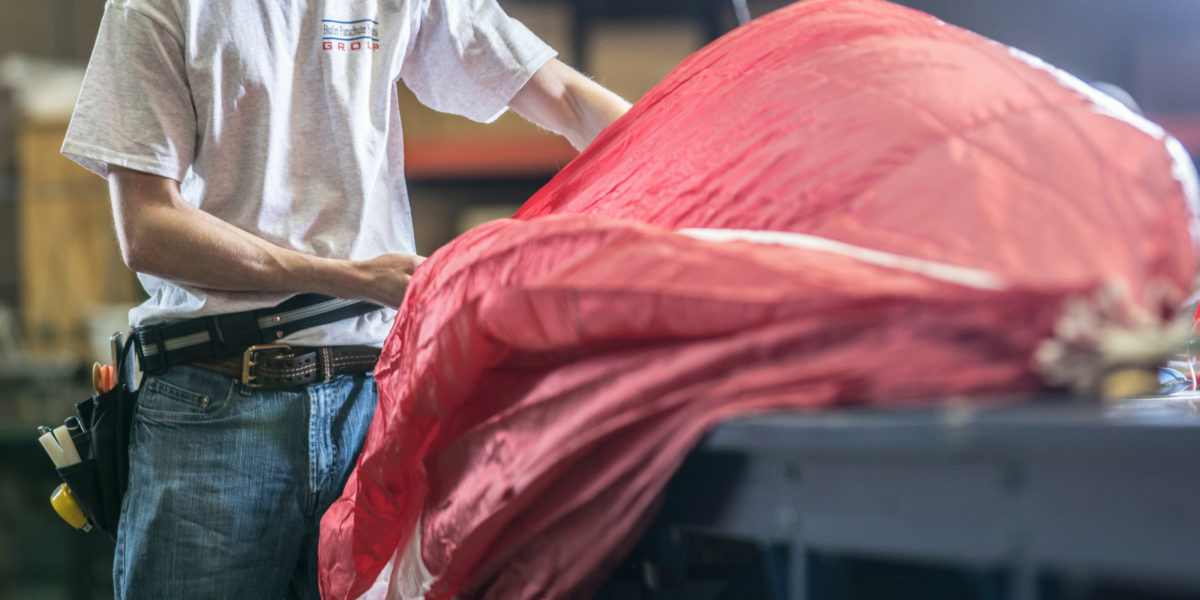
Butler Personnel Parachute Systems, LLC. maintains a full-service parachute loft and we are capable of servicing any type of emergency parachute equipment. In particular, we would like to service every parachute that we make at least once per year. This gives us the opportunity to track any wear and tear on the system and to check on the quality of service other parachute riggers in the field are giving our products. We will make every effort to ensure that your parachute is serviced in a timely manner and returned to you with a minimum of "down time". The following policies and procedures will help to ensure that when you send your parachute to us for servicing, the process will be a smooth one. If you have any questions, please do not hesitate to contact us.

We are here to keep you flying!


Shipping Your Parachute To Us

Please pack your parachute in the carrying bag that was originally supplied with it and include your packing instructions. Also, please take a minute to enclose a note that includes your name, address and telephone number, as well as instructions for the service you would like performed. A package that arrives without instructions can slow the process of servicing your parachute considerably. We recommend that the package be insured for full replacement value. In the unlikely event the package is lost, a fully insured parachute can be replaced without any financial burden to you.

When shipping rigs to us for repack use the following address:

Butler Personnel Parachute Systems, LLC.

1820 Loudon Avenue NW

Roanoke, VA 24017
 

While It's Here

Butler Personnel Parachute Systems will repair everything required for airworthiness and safety. Non-essential, but recommended, items will be noted on your invoice. If the estimated total cost of the service will exceed $200.00, we will notify you for authorization to make the repair before starting the work. We will routinely perform most appropriate updates on our own products at no charge to you. Any AD’s or other updates required for items manufactured by other companies will be handled on a case-by-case basis.


Priority of Service

Unless otherwise indicated in your note, we will service your system with the priority indicated by the method used for inbound shipping. Thus, if we receive a parachute by ground shipment, it will usually be serviced in not more than 5 working days. Second day shipments (UPS Blue or FedEx) will be serviced in not more than two working days and next day shipments (UPS Red and FedEx Priority) shipments will be serviced in not more than one working day. We may, at our sole discretion, charge an extra fee for rush services as follows: the 2-day service is an additional 50% of the normal service fee; the 1-day service is an additional 100% of the normal service fee.


Return Shipment to You

Unless otherwise indicated, the parachute will be returned to you by the same method used for inbound shipping. All packages are shipped by a traceable means and are insured for full replacement value unless otherwise directed by you in writing. Parachutes that include hazardous materials (such as signal flares, oxygen bottles, CO2 bottles, etc.) must generally be shipped by FedEx as HAZMAT and will require additional handling and fees.


Charges and Payment

Routine inspection and repacking on most manual bailout emergency parachute systems is $50 (although some are higher). Unusual items such as ejection seat parachutes will be billed on time and materials at our standard rates. We will bill you for the work done, and the shipping and insurance charges after completion. Please note that our terms are Net 10 days for routine repacks.


Legal Issues

In the United States, according to FAR 91.307, parachutes are required by law whenever engaged in aerobatics. In addition to these requirements, there are obviously other times when a chute is appropriate but not required by law. For example, most aircraft type organizations (T-34 Association, NATA, etc.) require the use of a parachute for formation flying; the Soaring Society of America and the International Aerobatics Club require parachutes for contest flying and so forth. It is (as usual) the pilot's responsibility to ensure that every parachute on the aircraft is legal for use. This means that each parachute must have been inspected and packed within the preceding 120 days (by a properly Certificated and appropriately rated parachute rigger) and that it is an "approved type." An approved type is one produced under Technical Standard Order (TSO) C23, or a personnel carrying military parachute produced in the United States to a US military drawing or contract as per FAR 91.307e. See our other publications for more details on approved types if needed.

Parachute riggers are licensed under Part 65 (as are aircraft mechanics) and are given as much (if not more) latitude in determining airworthiness as mechanics are allowed in aircraft. Therefore, you will see just as wide a range of standards and professionalism as seen in aircraft work.  


Workmanship and Airworthiness Standards

Butler Personnel Parachute Systems manufactures the finest emergency parachute systems in the world and we are always striving for continuous improvement in our products and services. Toward these goals, we maintain the highest standards for workmanship and professionalism in the world. Our standards are based on experience and knowledge developed over the past twenty years and are the toughest in the industry. However, they are not carved in stone and will occasionally change as we (and the industry) learn more about things such as contamination and aging effects and as we learn (and invent) better ways of doing things. For your information, we have included below a brief explanation of our airworthiness standards concerning the most commonly raised issues:

Age Limits:  Because most aging effects in nylon textile products cannot be detected without destructive testing, BPPS will not pack a parachute that is over 20 years old at the time of repacking. In some cases where new equivalent equipment is not available (primarily ejection seat systems), we will waive this requirement and conduct localized destructive testing (and repair) of components although this is usually not cost effective when considering the marginal extension to service life that it provides.

Strength Testing of Canopy Cloth:  BPPS will perform an appropriate (non-destructive) strength test on a randomly selected section of canopy cloth (at least one test on every color cloth) on every parachute that we pack, every time we pack it (even our own brand new parachutes). We use a 1" grab test at 40 lb. for most cloth. Each test location is marked with date and loft #.

Steerability of Parachute Canopies:  Because of the severe oscillations inherent in most types of non-steerable parachutes BPPS may refuse to pack a parachute that is not steerable. The "4-line release" system is a simple and low cost modification which is available and appropriate for most non-steerable chutes.

Legality vs. Safety:  Under no circumstances will BPPS ever return an unsafe parachute to use. However, under some circumstances (such as imported military items that are otherwise acceptable and airworthy) we may pack a parachute for use even though it may not meet all the conditions of FAR 91.307. In this situation, you will be informed of the circumstances and your packing data card and the invoice will be so noted.

If some of these policies seem unreasonable to you, we suggest that you seriously consider whether a parachute rigger is really doing you a favor by returning a marginal parachute to service. Also remember that when a rigger signs the data card, he/she is certifying that the parachute is airworthy and he/she is subject to sanctions and penalties just as any other FAA license holder. Don’t ask your rigger to risk his livelihood so that you get by for "just one more time".


Repack Interval/Service Life Outside the United States

All personnel parachutes manufactured by Butler Personnel Parachute Systems, LLC. are manufactured and authorized under the Technical Standard Order (C23b/c/d) processes of the Department of Transportation, Federal Aviation Administration (FAA). Our products have been sold all over the world and thus may fall under many other sets of operating regulations. The following guidance is provided for determination of the allowable service life and repack interval under the specific circumstances listed:

When used in civil aircraft in the United States of America, under the rules and regulations of the Federal Aviation Administration BPPS personnel parachutes have an estimated service life of 20 years. However, parachutes must be inspected and repacked in accordance with the applicable service manuals and Federal Aviation Regulations, every 120 days. If more than 120 days has passed since the last inspection and repack then the parachute is considered unairworthy until such inspection is accomplished.

When used in military aircraft operated by the United States of America (i.e., not under FAA control), BPPS personnel parachutes have an estimated service life of 14 years, which may be extended to 20 years upon inspection by BPPS. In the absence of command guidance to the contrary, BPS parachutes may be inspected and repacked in accordance with the applicable service manuals and directives at intervals not to exceed 1 year (365 days). In extenuating circumstances (combat deployment, etc.), with specific guidance and authorization from BPS, the inspection and repack cycle may be extended up to 18 months. However, in all cases, an external inspection (sufficient to detect any evidence of tampering or contamination) must be performed at intervals not to exceed 120 days.

When used in civil (or non-US military) aircraft outside the United States of America, this parachute has an estimated service life of 20 years and the local regulations pertaining to parachute inspection and repacking (if any) may be applied. However, in no case should the inspection and repack cycle be extended beyond 1 year (365 days) without specific guidance and authorization from BPPS. However, in all cases, an external inspection (sufficient to detect any evidence of tampering or contamination) must be performed at intervals not to exceed 120 days.


 CAUTION: The above information is provided as general guidance only; if your situation is not covered, please contact BPPS for further guidance.
